
The arrival of Lucasfilm adventure games at the dawn of the 1990s feels, in retrospect, like a fault line in time. A distinct turning point. The arrival of some bespectacled and bearded deity bearing gifts.
There is BC — Bad Code — and there is AD — After Death. What adventure gaming was before this seismic event bears little resemblance to what followed. A sort of Old Testament of mountain-splitting fury at the smallest transgression, swept aside by a glorious new age of peaceful, open enlightenment.
An enlightenment built on free thinking, curious minds, and the particular pleasure of a world that rewards exploration rather than punishing it.
And that enlightenment has a very specific feeling. It arrives at the exact moment when two completely unrelated things — a rubber chicken and a pulley, say, or a three-headed monkey and a sword fight — suddenly coalesce into a solution so brilliantly logical in retrospect that you feel simultaneously like a genius for working it out and an idiot for taking so long.
Fear not, my child. For these are forgiving gods.
We are blessed to have been bestowed such glorious gaming gifts. So let us set out on our adventure — through the eyes of my personal childhood pilgrimage — into a world of insulted pirates, a wise-cracking skull, a dead travel agent, a tentacle with nuclear ambitions, and the most consequential cliff fall in video game history.
Point. Click. And be Blessed.
The World Before LucasArts Made It Bearable
To understand what LucasArts did, you have to understand what adventure games were like before they arrived to fix them. And fix them they did, because by the mid-1980s the genre had developed a rather alarming sadistic streak. Like a prison guard plagued by a fragile ego and itchy trigger finger.
The early text adventure — navigating by typing NORTH, SOUTH, GET LAMP, CURSE AT SCREEN — had given way to graphical adventures from Sierra On-Line. King’s Quest, Space Quest, Leisure Suit Larry: games you could actually see, populated with real characters rather than text descriptions, which felt miraculous at the time.
They were also, by any reasonable modern standard, absolutely merciless. Gleefully, creatively, almost impressively merciless.
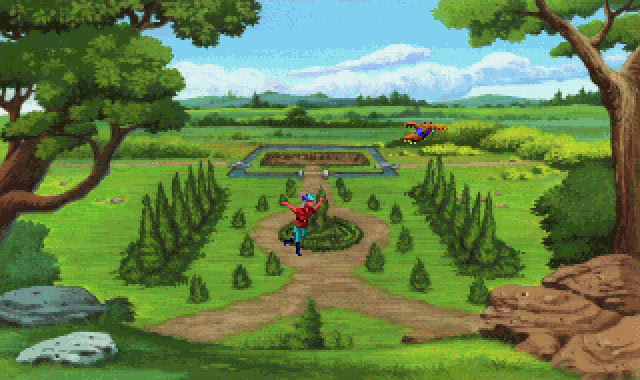
Sierra’s adventure games operated on a philosophy of designed suffering. You could be walking through a forest, entirely minding your own business, and suddenly die because you’d failed to pick up a specific item in a room you’d visited an hour ago.
You could reach a point twenty hours into a game and realise, with dawning horror, that a decision made in the opening minutes had rendered completion mathematically impossible — a concept the genre pleasantly termed the “dead end,” as though it were a minor inconvenience rather than a complete waste of your afternoon.
King’s Quest IV had a particularly rich variety of ways to kill you, deploying a kind of creative sadism that suggested the designers had a quota. In one memorable incident you could be killed by a cat. Not a boss. Not a monster. A house cat. Presumably Sierra considered this character building, I consider it abuse.
The player’s response to all of this was to save obsessively — after every screen, every object interaction, every conversation — building up a library of save states like a paranoid bureaucrat hedging against futures that had already happened. Save1. Save2. Save2b. Save2b_ACTUAL. Save2b_ACTUAL_beforethecat. It was gaming as anxiety management, and the cat was always coming.
Ron Gilbert had opinions about this. Strong ones. And unlike most people with strong opinions about game design, he actually did something about it.
Ron Gilbert Writes a Manifesto
In December 1989, Gilbert — already a designer at Lucasfilm Games with Maniac Mansion under his belt — published an essay titled “Why Adventure Games Suck: And What We Can Do About It.” It is one of the most quietly revolutionary documents in game design history, and it reads, even now, like someone calmly and methodically dismantling a building that everyone else had simply accepted as load-bearing.
His argument was beautifully simple: adventure games were failing players by confusing difficulty with cruelty. A puzzle that kills you for failing to find it isn’t a puzzle — it’s an ambush. A game that lets you reach an unwinnable state without telling you isn’t challenging — it’s broken. The player’s imagination and curiosity should be rewarded, not punished. Adventure games should be places to explore with enthusiasm rather than mazes to navigate with existential dread.
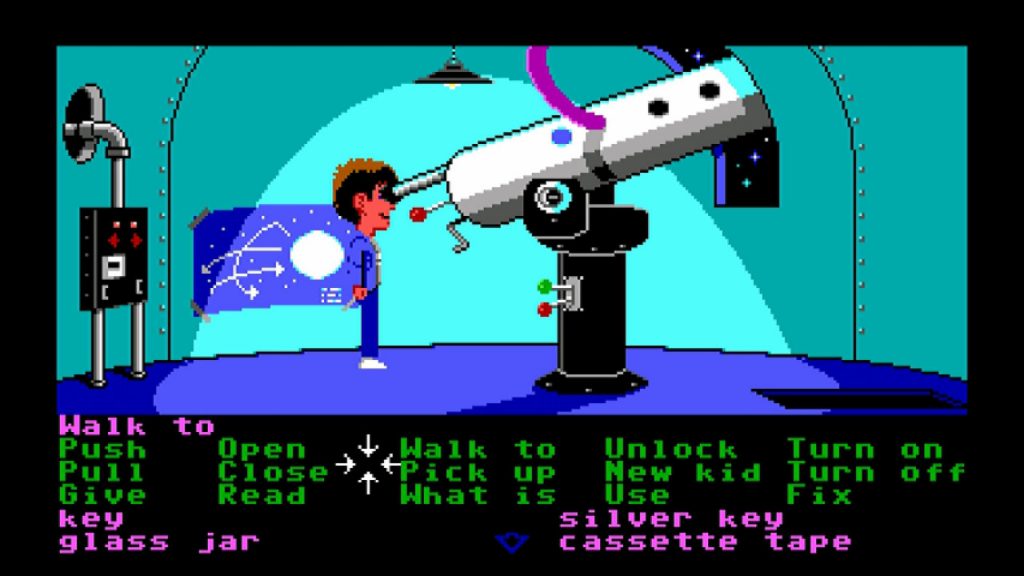
The engine he’d already built to fix all of this — SCUMM, the Script Creation Utility for Maniac Mansion — was the practical expression of that philosophy. A verb-and-object interface letting players interact with the world through clearly visible actions: Give, Open, Pick Up, Talk To, Use. No obscure text parser to appease. No unexpected death for mis-phrasing a command. The player controlled the pace and the curiosity. The world was there to be explored rather than feared.
The name, incidentally, was not an accident — the SCUMM Bar appears in The Secret of Monkey Island as a direct wink to anyone paying attention, and SCUMM’s ingredients are listed on a bottle of grog in the same game. Gilbert and his colleagues named their internal tools after bodily fluids almost exclusively — SCUMM, SPUTM, FLEM, MMUCUS — which tells you something important about the culture they were building. Specifically, that they were having the absolute time of their lives and nobody in management had yet noticed.
Guybrush Falls Off a Cliff
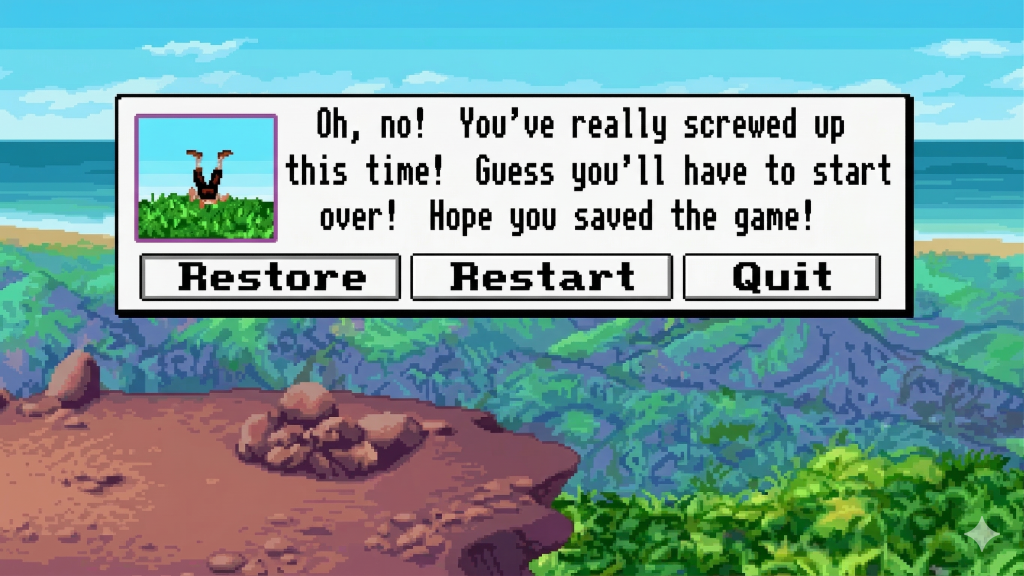
The Secret of Monkey Island arrived in 1990 and changed everything, but no single moment captures the revolution more perfectly than one that lasts about four seconds.
Late in the game, on Monkey Island itself, you can walk Guybrush — our prissy wet-teabag of a protagonist, wearer of enormous trousers, and proud owner of a supposedly documented ability to hold his breath for ten minutes — to the edge of a cliff and watch him fall off.
In a Sierra game, this is where a death jingle plays, Guybrush meets his sticky end, and you reload a save from three screens ago because you’re not an amateur. In Monkey Island, Guybrush bounces straight back up, lands on his feet with the cheerful indestructibility of a cartoon character, and the game simply continues.
It is the shortest, most efficient design statement in the history of the medium. In four seconds, without a single word of dialogue, Gilbert and his team told the player: we are not going to kill you. This is a place to play, not a gauntlet to survive. You are safe to be curious. Go and have fun. An entire design philosophy, delivered via a man in oversized trousers bouncing off a rock.
The insult sword fighting system, in which Guybrush wins duels not by swinging a blade but by trading devastating verbal put-downs, is a design masterstroke
The game built on that promise relentlessly. The puzzles were logical — deeply, satisfyingly logical. A rubber chicken with a pulley in the middle is, on reflection, an entirely reasonable tool for crossing a zip line between islands. The game makes you believe this completely, which is either a testament to its internal consistency or evidence that it rewired something fundamental in the brains of everyone who played it.
The dialogue was funnier than your average comedy at the time. The insult sword fighting system — in which Guybrush wins duels not by swinging a blade but by trading devastating verbal put-downs — is a design masterstroke that rewards the game’s own writing rather than the player’s reflexes. It also taught an entire generation of children their first lessons in the art of the comeback, which their parents later regretted. Calling your menopausal Mum a cow and fighting like one probably wasn’t the smartest move if you wanted to eat dinner that night.
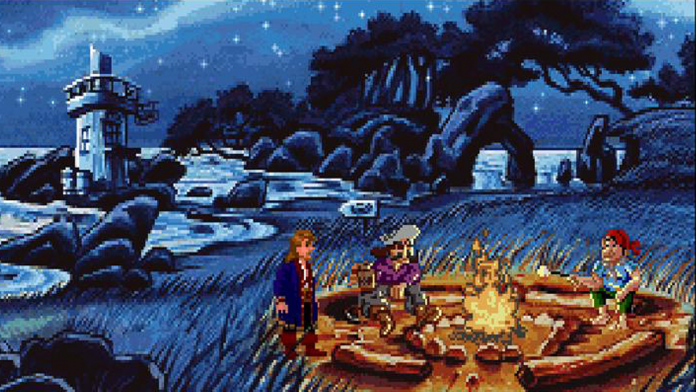
I first encountered Guybrush Threepwood at around age eight, on an Amiga 500, in circumstances that required considerable parental tolerance for a child who kept disappearing upstairs. Monkey Island wasn’t just a game, it was a place. I went back to it repeatedly, not because I’d forgotten the puzzles, but because I simply wanted to be back in it, giggling at the sheer quirkiness of it all.
As Gilbert himself put it: “The Secret of Monkey Island is certainly still my favourite of the games I’ve done. It’s tight. Every puzzle I thought about ad nauseam.” You can tell.
Monkey Island 2: LeChuck’s Revenge — Eleven Disks of Pure Stubbornness
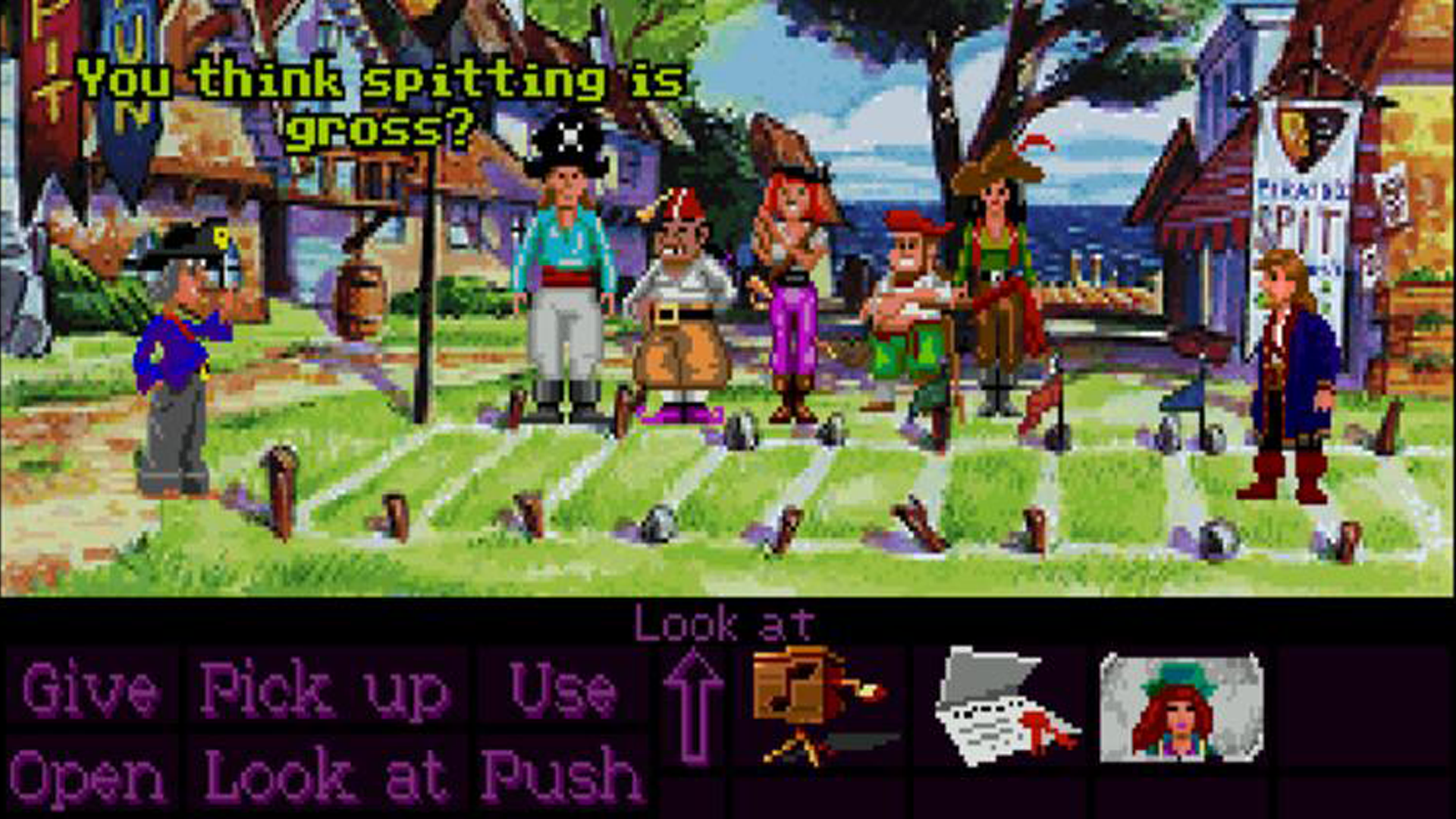
1991’s Monkey Island 2: LeChuck’s Revenge arrived with a bigger budget, a darker tone, and puzzles of such Byzantine ingenuity that they still inspire heated community debate about whether they’re fair or absolutely diabolical. The answer, for what it’s worth, is both — simultaneously, depending on which puzzle you’re currently stuck on.
The Largo LeGrande puzzle sequence alone has caused more abandoned playthroughs than any Sierra death trap — the difference being that here you’re not killed, just left standing in a swamp wondering what on earth a voodoo doll has to do with a bra, the dandruff from the bad guy’s toupee, and a bone stolen from his grandfather’s crypt. The answer, when it arrives, is perfectly logical. Getting there takes the kind of lateral thinking that either genuinely delights you or sends you directly to a FAQ with your dignity in tatters.
Speaking of LeGrande, his villain theme tune — spluttered from the crude motherboard speaker of my Dad’s old 386 — has lodged in my head like a pensioner at a discount Sunday carvery: stubborn, settled, and going absolutely nowhere.
On a related note, the iMUSE system, debuting here and carrying through the LucasArts catalogue, deserves special mention: a system that transitioned musical themes dynamically based on where you were and what you were doing, so the soundtrack actually responded to the world rather than sitting in the background doing its own oblivious thing. In 1991 PC audio terms, extraordinary.
It also arrived, on the Amiga, on eleven floppy disks. Eleven. You would swap disks to enter a room, swap again to have a conversation, and swap a third time because the game had apparently decided you’d been comfortable for long enough. It was like a messed-up game of UNO.
The sheer physical commitment required to play LeChuck’s Revenge in 1991 was itself a kind of puzzle — one with no in-game hint system and a very real risk of losing disk seven behind a radiator. That people played through to completion regardless tells you exactly how good it was.
LeChuck’s Revenge was Ron Gilbert’s final Monkey Island game — he left LucasArts shortly after completion, reportedly without ever revealing the actual secret of Monkey Island to his colleagues. The game ends on a note of genuine surreal strangeness that divided players at the time and has been discussed with increasing fascination ever since. In 2022, Return to Monkey Island finally — sort of — addressed where that ending was always going.
The fact that players were still arguing about it thirty years later is testament to how deeply the game had burrowed into its audience.
Day of the Tentacle — A Revelation in Someone Else’s Living Room
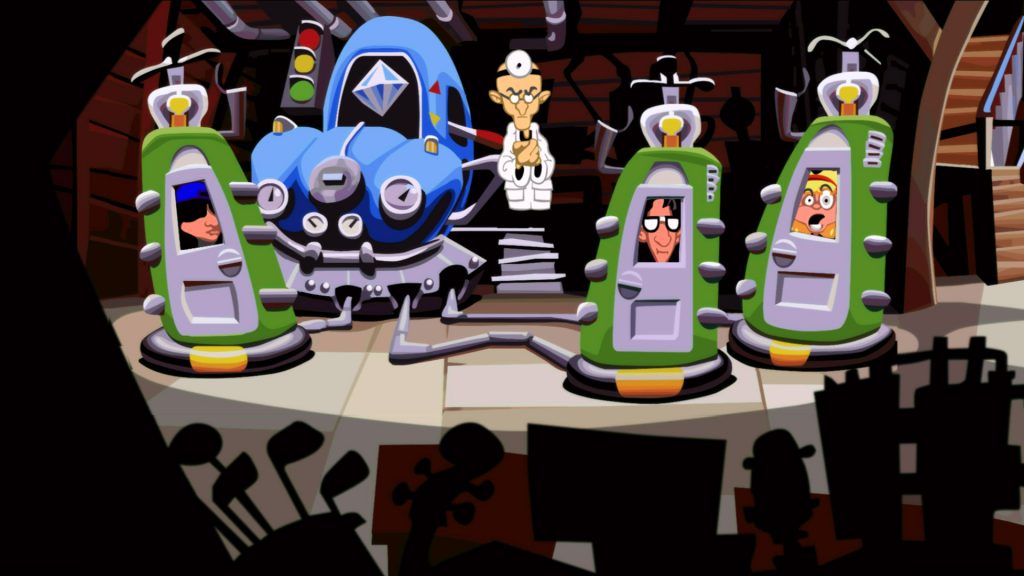
Day of the Tentacle arrived in 1993 bearing Tim Schafer and Dave Grossman’s names as lead designers — their graduation piece after serving as writers and programmers on the Monkey Island games. It remains arguably the funniest game ever made, which is a bold claim I will happily defend.
The premise is a time-travel comedy in which three characters — the hapless Bernard, the vaguely anarchic Laverne, and the musically inclined roadie Hoagie — become stranded across three different eras: colonial America, the present day, and a near-future ruled by sentient tentacles.
If you’re wondering how America ended up governed by tentacles, the answer involves a mutant purple tentacle drinking toxic sludge, sprouting arms and immediately developing world domination ambitions alongside an alarming amount of self-confidence — a sequence of events that, written down like that, sounds entirely plausible in 2026.
The structural elegance of Day of the Tentacle is underappreciated relative to its comedy, but the two are genuinely inseparable. Multi-character, multi-era puzzle design of this internal consistency is something most games can’t manage within a single timeframe. That Schafer and Grossman pulled it off while maintaining a comedy standard that had Steven Spielberg ringing the LucasArts offices for hints — genuinely, he got stuck while playing it with his son — tells you everything about the calibre of work being produced.
Schafer later called it “the last fun game I ever worked on,” which is as much a statement about what came next as it is about what this was.
I have a vivid memory of discovering the game for the first time at a party hosted by my stepfather’s boss — an avid PC tinkerer who was positively beaming as he showed off the fancy real-life voices humming from a pair of beige desktop speakers not far off tentacle-shaped. The characters spoke. Actual human voices, coming out of a computer, saying funny things, in real time. The effect was roughly equivalent to watching someone pull a rabbit from a hat, except the rabbit was also doing a voice.
The distinct caricature accents of that bizarre cast of misfits have sat firmly in my mind ever since. But deliberately ruining poor Ed Edison’s prized stamp collection? That still amuses and haunts me in equal measure. Still, at least he doesn’t have those “bad thoughts” anymore.
The magazine acknowledged the game’s American humour wasn’t for everyone
PC ZONE knew exactly what it had on its hands when issue 7 landed. Scoring it 87%, the magazine acknowledged the American humour wasn’t universally accessible — “unfortunately it’s so full of American college humour that it’s not as accessible as the two Monkey Island games” — while conceding it “definitely has its moments and the animation is stunning.” A fair verdict for 1993, and one that time has considerably revised upward. The animation that impressed PC ZONE then looks like a statement of artistic intent now.
The Remastered Edition adds updated visuals while letting you switch back to the original at any point. The original Maniac Mansion — the game to which Day of the Tentacle is a sequel — is playable as a game within the game. This is either an extraordinary piece of bonus content or the greatest Easter egg in adventure game history. I’m going with the latter.
The Curse of Monkey Island — My Personal Desert Island Disc
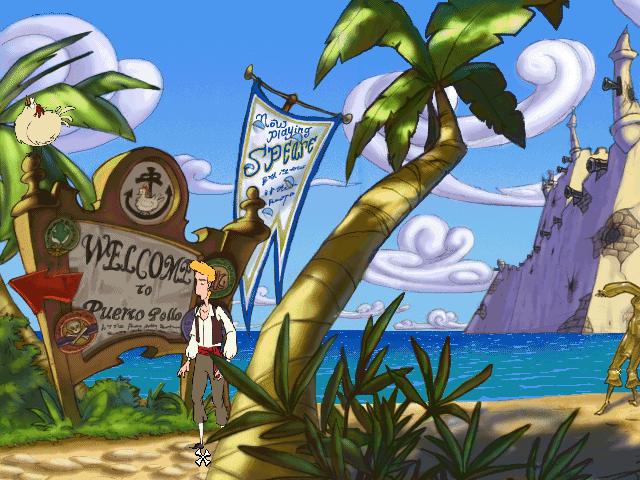
A brief but necessary note on The Curse of Monkey Island (1997). It is a wonderful game — visually sumptuous, genuinely funny, with a hand-drawn cartoon style that remains beautiful nearly thirty years later. Guybrush finally gets a voice, and Dominic Armato’s performance is so perfectly calibrated it retroactively defines the character across every subsequent appearance.
It is also the first Monkey Island game made without Ron Gilbert, who departed in 1992. Directed by Jonathan Ackley and Larry Ahern, Curse is faithful to the spirit of the originals while being considerably more immediately accessible than the demanding LeChuck’s Revenge.
It was the last game to use the SCUMM engine — an elegant full stop to a remarkable technical chapter. That it brings back the rubber chicken with a pulley in the middle as a knowing callback tells you everything about how lovingly it was made by people who understood exactly what they’d inherited.
Warmer than LeChuck’s Revenge, funnier than the original, and more consistently delightful
This is a genuinely held position and not contrarianism: Curse of Monkey Island is my personal favourite entry in the series. It is warmer than LeChuck’s Revenge, funnier than the original, and more consistently delightful than anything that followed. It currently lives on Steam, permanently installed, ready for when the itch returns. And it always returns. We all live in quiet hope for a remaster, because that hand-drawn art deserves resolutions that didn’t exist in 1997. Guybrush deserves better than 640×480. So do we all.
PC ZONE agreed, awarding it 92% in issue 58. The reviewer — who styled herself the “highly revered Queen of Monkey Island” — captured something that no amount of dry critical analysis quite manages: “It’s such a cutie wootie, comforting game. It’s where you’ve been before. You know it. You love it. It’s warm. It’s snug. There’s nothing earth-shatteringly new gameplay-wise, yet it’s impossible to put down.” She went on to list everything that made it sing — the jingly-jangly music, the bad jokes, the self-mocking humour and the ingenious yet peculiarly logical puzzles. Amen, sister.
Grim Fandango — The One They Made After Everyone Had Gone Home
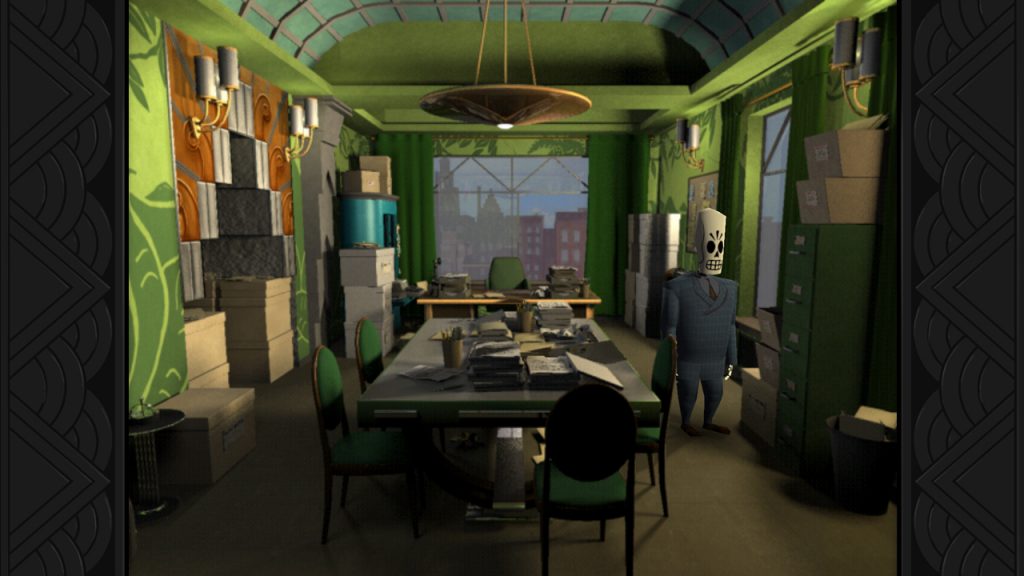
And then there is Grim Fandango. Oh, Grim Fandango.
Tim Schafer’s 1998 masterpiece is the kind of game people who played it at the time describe with the slightly evangelical fervour of someone who witnessed something they know can never be fully communicated to someone who wasn’t there. A noir adventure set in the Aztec Land of the Dead.
A skeleton travel agent named Manny Calavera navigating corruption, betrayal, and love across a four-year journey through the afterlife. A visual style combining art deco architecture, 1950s fashion, and Mexican folk art into something that looked like nothing else on any platform, ever.
A script borrowing from Casablanca, The Maltese Falcon, and Chinatown while being entirely, specifically itself. And a giant orange demon called Glottis who serves as Manny’s driver, mechanic, and emotional support system, and who at one point develops a catastrophic gambling addiction that the plot requires you to personally facilitate. Grim Fandango contains multitudes.
It was the first LucasArts adventure to abandon SCUMM entirely, moving to a new 3D engine that Schafer pushed for after being seduced by how dramatically camera angles could change in three dimensions. It had the profound misfortune of arriving precisely as the adventure game genre was falling out of commercial fashion — squeezed between the rise of RTS games, the FPS revolution, and an industry increasingly persuaded that people would rather shoot things than talk to them.
As a conclusion about humanity, fairly grim. The game sold approximately 500,000 copies, which LucasArts considered disappointing. In retrospect this is roughly equivalent to a record label dropping a band after their debut sells half a million copies, then spending the next twenty years wondering why nothing sounds as good anymore.
GameSpot gave Grim Fandango its Game of the Year award for 1998. Reviews were extraordinary. None of it was enough.
if the doom-mongers were right and adventure games really were finished, “Grim Fandango at least provides us with a f**ing good lock-in.”*
PC ZONE gave it 90% in issue 71 — and closed the review with a line that deserves to be in a museum. After praising “its expert direction, costumes, characters, music and atmosphere” and calling it “a subtle blend of lateral thinking, arcade puzzles, bizarre settings, outlandish characters and seamless cut-scenes,” the reviewer noted that if the doom-mongers were right and adventure games were genuinely finished, “Grim Fandango at least provides us with a f**ing good lock-in.”*
That is the finest single sentence ever written about the end of a genre. The fact that PC ZONE wrote it, about this game, at this exact moment, is precisely what made the magazine worth reading.
The Remastered Edition — released by Schafer’s Double Fine Productions in 2015 after years of the original being unplayable on modern hardware — adds a redone orchestrated score, updated graphics, and directors’ commentary. The original tank controls, which Schafer later acknowledged were a mistake, can be swapped for point-and-click. Both options remain. The tank controls, once mastered, have a certain period charm. Play however you wish. Just play it.
Why It Ended
The story of how LucasArts abandoned adventure games is both simple and depressing, as stories about creative institutions walking away from the things that made them special tend to be.
The mid-1990s saw the action game ascendant, the FPS genre exploding after Doom, and audiences broadening in ways that didn’t favour games requiring patience, inventory management, and a willingness to be stumped for extended periods.
The argument, roughly translated, was that people would rather shoot things than talk to them — commercially defensible, and as a statement about humanity, fairly grim. LucasArts followed the money. The designers who’d built the golden age left in a steady stream — Schafer to found Double Fine Productions in 2000, many others eventually forming Telltale Games in 2005.
LucasArts was absorbed into Disney in 2012 and shut down as a developer in 2013.
The golden age was over. What it left behind was extraordinary.
What Scratches the Itch Today
The good news — and it is genuinely good news — is that 2026 is an excellent time to be an adventure game fan, provided you know where to look.
Return to Monkey Island (2022) is the obvious starting point, and it is better than it had any right to be. Ron Gilbert returned to the series thirty years later, picked up directly from the end of LeChuck’s Revenge, and delivered something simultaneously a love letter to the originals and a genuinely new argument about what adventure games can do. The art style divided the community before anyone had played it, which is both predictable and irrelevant — it is beautiful, expressive, and entirely appropriate to the story being told. The ending is divisive. The journey is magnificent. We reviewed it — go and have a read.
Thimbleweed Park (2017) is Gilbert and Gary Winnick’s earlier return to form — a supernatural murder mystery in a small American town that wears its LucasArts influences with absolute transparency. Chunky pixel art, a verb interface lifted almost directly from Maniac Mansion, fiendish multi-character puzzles, and a sense of humour that navigates between warm and genuinely strange. It is the closest thing to a lost LucasArts classic that actually exists, because it was made by the same people.
Disco Elysium (2019) is not, technically, a point-and-click adventure in the LucasArts tradition — it’s an isometric RPG built around dialogue choices and a breathtakingly ambitious skill system. But its DNA is adventure game through and through: the emphasis on conversation over combat, the inventory-based puzzle solving, the world that rewards curiosity and punishes nothing. It has the best writing in any game made since Grim Fandango, and that is not a sentence typed lightly.
Loco Motive (2024) is the most recent entry worth shouting about — a whodunit set aboard a moving train, three playable characters, and a level of polish that makes it feel, as one reviewer put it, like “a lost LucasArts adventure from the genre’s Golden Era.” High praise, and on the basis of the game itself, entirely justified.
For the classics themselves, ScummVM — a free, open-source engine that allows the original SCUMM games to run on modern hardware — means that every LucasArts adventure discussed in this piece is playable today on virtually any device you own. The games are available on Steam and GOG, with the remastered versions of Day of the Tentacle, Full Throttle, and Grim Fandango representing the most accessible entry points for anyone coming to them fresh.
The Lasting Argument
Ron Gilbert’s 1989 manifesto argued that adventure games fail when they confuse punishment with challenge, randomness with difficulty, and the designer’s convenience with the player’s enjoyment.
What LucasArts built across the following decade was the fullest expression of the opposite — games designed around trust, curiosity, and the particular pleasure of a mind genuinely engaged with a world that doesn’t want to kill it. All delivered with some genuinely fine humour, through a cast of highly memorable and ridiculously daft characters you couldn’t help but love.
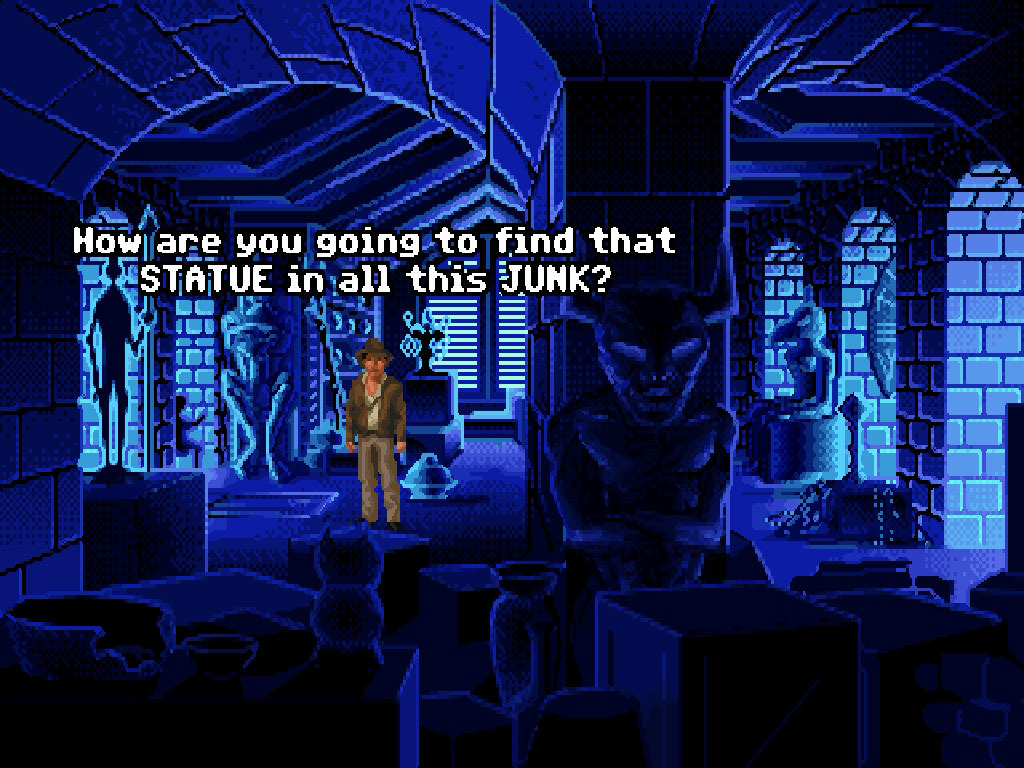
I never got around to playing Sam & Max Hit the Road or, sacrilegiously I know, what many consider the best of the bunch — Indiana Jones and the Fate of Atlantis. Thankfully, both are readily available for a few measly quid on Steam. Worth every penny, I’d wager, once I finally get round to them.
My childhood ramblings with Monkey Island, Day of the Tentacle and Grim Fandango are not, in 2026, merely the nostalgic rose-tinted rememberings of a snot-nosed squit. They are not the oh-so-charming relics of a simpler time. They are exceptionally well-designed, beautifully written, lovingly crafted games that simply happen to be thirty years old.
I still don’t know what the secret of Monkey Island actually is — and if Ron Gilbert knows, he’s still not telling. Like the meaning of life, perhaps such secrets are known only to the divine. Maybe just one more playthrough will reveal the answer. I still have faith…
The Secret of Monkey Island, Monkey Island 2: LeChuck’s Revenge, and The Curse of Monkey Island are available as The Monkey Island Collection on Steam. Day of the Tentacle Remastered, and Grim Fandango Remastered are available individually on Steam and GOG. All classic LucasArts SCUMM games are supported by ScummVM.