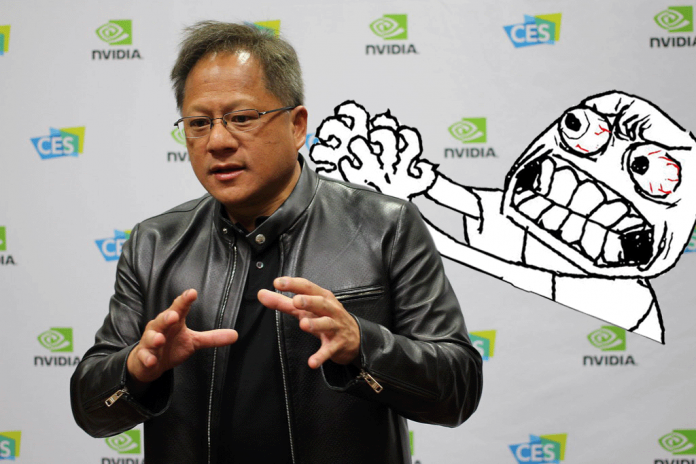

If you’ve spent five minutes wading through the comment sections this week, you’d be forgiven for thinking NVIDIA had just announced they were replacing every beloved game protagonist with a sentient, airbrushed mannequin.
According to the digital lynch mob, gaming is officially dead — and anyone caught even mildly enjoying Jensen’s latest tech isn’t just a traitor, they should be purged with the kind of vein-popping theatricality usually reserved for Christian Bale discovering a lighting technician wandering into his eye-line.
The backlash to DLSS 5 — or “Neural Rendering,” as Jensen likes to call it while gazing down from his glass-and-steel ivory tower — has been nothing short of nuclear. The purists are up in arms. “It’s AI slop!” they cry. “It’s destroying the artist’s intent!” they scream, clutching their copies of Quake II and dreaming of a world where a pixel was a pixel and not a “probabilistic suggestion” generated by a data centre in Taiwan.
Which is, frankly, a bit rich coming from a community that spent the last decade downloading 4K HD texture packs that turn Skyrim into a neon-soaked fever dream, inflate every female character into a physics-defying balloon-chested caricature, and swap a gloriously rendered, meticulously human-designed dragon for Thomas the fucking Tank Engine.
But here’s the cold, hard truth: DLSS 5 isn’t just coming — its core technologies may become necessary. There. I said it. Aim your bile-slobbering death threats accordingly.
The Efficiency of the Machine
Let’s be honest about where AAA development currently stands. These bloated behemoths are haemorrhaging hundreds of millions of dollars and consuming half a decade of human endeavour just to reach the finish line — often in a state so half-baked they’re practically raw dough. Developers are being stretched thinner than the skin on a budget sausage. Studios are closing at a rate that would have seemed dystopian five years ago.
AI offers an almost impossible-to-resist way out of much of this mess. It’s cheaper, faster, and — as much as it pains the native-resolution faithful to hear — it’s getting smarter at a rate that should genuinely unsettle everyone. If a developer can use Neural Geometry to reconstruct the pores on a character’s face instead of paying a junior artist three months’ salary to sculpt them manually, they’re going to do it. Not because they’re evil. Because they’re a business, and the maths is overwhelming.
Is that bad for some people in the industry? Absolutely. Will the executives lose sleep over it if it helps the bottom line? Of course not. We’ve been automating ourselves out of jobs since the first steam engine coughed soot into a Victorian sky, and the gears don’t stop grinding because a mob of furious Redditors is having a collective meltdown. The uncomfortable reality is that AI is becoming proficient enough, fast enough, that the “human touch” is starting to look like an optional extra rather than an irreplaceable ingredient. Jensen Huang is sitting in the cockpit of that particular journey — and he knows exactly where it’s headed.
The “Integrity” Myth
The biggest stick used to beat DLSS 5 has been the Artist’s Intent argument. Critics pointed at the Resident Evil Requiem demo, claiming the AI made characters look “too glossy,” too processed — an Instagram filter masquerading as a technical achievement.
But since when has a PC game been a static, untouchable piece of art? We change the FOV. We turn off motion blur (thank god). We inject ReShade filters and mod the living daylights out of everything from Cyberpunk to Stardew Valley. A game’s look has always been a conversation between the engine and the user’s hardware. DLSS 5 just adds a very fast, very opinionated painter to that conversation. The “integrity” was negotiable long before Jensen showed up in a leather jacket.
The Real Reason You’re Angry
If we’re being straight with each other, the rage isn’t really about the pixels at all.
It’s about the context. NVIDIA has become the ultimate corporate villain — Jensen standing on stage dismissively telling us we’re “completely wrong” for noticing that the AI is smoothing out eye bags, while RTX 5090s sell for prices that resemble phone numbers and the hobby we love feels increasingly like it’s being sold off to Silicon Valley’s LLM obsession. We’re the beta testers paying for the privilege of someone else’s revolution.
That’s a legitimate grievance. The anger makes sense. But the target is slightly off.
DLSS 5 is the symptom, not the disease. The disease is an industry where the economics of making games have become so punishing that any technology promising to cut costs gets adopted regardless of the cultural discomfort it causes. You can be furious about that — you probably should be — without pretending that the technology itself is the villain.
The Verdict
DLSS 5 will launch this autumn. The purists will moan, the memes will be top-tier, and Jensen will probably wear an even shinier jacket. But three years from now, when you’re running a photorealistic RPG at 120fps on a mid-range card that would have been on its knees without the machine-learning underneath it, you probably won’t be thinking about artistic intent.
You’ll just be playing the game.
The AI genie isn’t going back in the bottle — it’s too busy rendering your angry reflection in a puddle. And if that’s genuinely too much of a moral compromise, you can always turn DLSS 5 off. That option, at least, remains entirely yours.