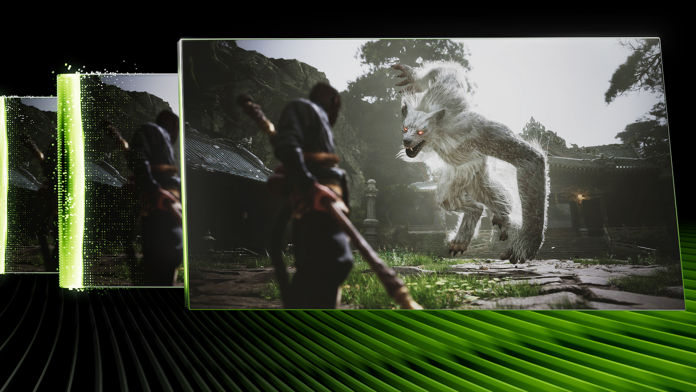

What does “fake” even mean in a video game? Seriously. Unless you’re currently dodging actual shrapnel or getting mauled by a literal dragon, newsflash: every single pixel on your screen is a lie. Yet “fake” has become the favourite war-cry of a particular breed of internet martyr. You know the type — the keyboard crusader camping Reddit threads like they’re defending the Holy Grail. To these pixel purists, if a frame wasn’t sweated out through the brute-force labour of a $2,000 GPU, it’s somehow “invalid.”
I’m talking, of course, about NVIDIA’s DLSS Frame Generation. And here’s the thing: some of the critics aren’t entirely wrong. They’re mostly wrong. But let’s do them the courtesy of actually engaging with what they’re saying before we dismiss them — because that’s what separates opinion journalism from a Reddit comment with a word count.
The Magic Show (And How It Actually Works)
Quick recap for the back of the class. DLSS (Deep Learning Super Sampling) renders your game at a lower resolution, then uses a trained neural network to reconstruct the missing detail — not by guessing randomly, but by analysing patterns across millions of frames of training data to make remarkably accurate predictions about what those pixels should look like. The results at Quality mode are, for most people in most games, indistinguishable from native.
Frame Generation goes a step further. Rather than upscaling resolution, it inserts entirely new, AI-predicted frames between the real ones your GPU actually rendered. It does this using optical flow analysis — essentially, it watches how pixels are moving between two real frames and calculates what a plausible intermediate frame would look like. The result is smoother motion, higher displayed frame rates, and a GPU that’s doing far less of the heavy lifting it used to.
At CES 2026, NVIDIA unveiled DLSS 4.5 with a 6x frame generation multiplier. That means for every one frame your GPU physically renders, the AI can produce five more. Your GPU renders 20fps; your monitor displays 120fps. That’s either witchcraft or engineering, depending on your disposition.
The Case for the Prosecution
Here’s where I’m going to do something the “embrace the future, grandad” crowd rarely bothers with: take the critics seriously.
The most legitimate objection to Frame Generation isn’t aesthetic snobbery. It’s input latency. Because those interpolated frames are generated after the real frame is rendered, they don’t reflect any new input you’ve made — your mouse movement, your trigger pull, your dodge. The AI is essentially showing you a prediction of the recent past, not a response to the present. At high multipliers, this creates a disconnect between what your hands are doing and what your eyes are seeing. Frame Generation makes your game look smoother while potentially making it feel slightly less responsive.
These are legitimate technical limitations. Anyone telling you otherwise is selling something — possibly an RTX 5000-series card.
For competitive multiplayer — your Valo, your CS2, your anything-with-a-ranked-mode — this is a real and valid concern. Professional players have been exploiting even 1ms latency advantages for years. Asking them to embrace AI-generated frames is like asking a Formula 1 driver to appreciate the ambient lighting in a car that handles slightly worse.
There’s also the artefact problem. Frame Generation is genuinely impressive, but it’s not magic. Fast-moving objects, HUD elements, and anything with hard geometric edges can produce ghosting, smearing, or visual glitches — particularly at aggressive multiplier settings. DLSS 4.5 is significantly better than its predecessors in this regard, but it’s not solved.
These are legitimate technical limitations. Anyone telling you otherwise is selling something — possibly an RTX 5000-series card.
Now, Why They’re Still Mostly Wrong
Here’s the thing: the latency argument, while technically valid, applies to a vanishingly small portion of actual PC gaming.
According to Steam’s own hardware surveys, the median gamer is not running a 360Hz esports monitor and practising flick shots for six hours a day. They’re playing single-player RPGs, open-world adventures, story games, or online titles at a casual level where a few milliseconds of additional latency is entirely imperceptible. For those people — the majority — Frame Generation is an unambiguous win. More frames. Smoother motion. Same GPU.
Even NVIDIA acknowledges the latency trade-off, which is why they’ve paired Frame Generation with NVIDIA Reflex — a technology specifically designed to minimise input latency by optimising the CPU-GPU render pipeline. The net result, in supported games, is that Frame Generation + Reflex delivers lower latency than Frame Generation alone, and in many cases comparable latency to running without Frame Generation at all. It’s not perfect, but it’s evidence that NVIDIA is aware of the problem and engineering around it rather than pretending it doesn’t exist.
As for artefacts: yes, they exist. Yes, they’re occasionally annoying. But they’re also getting rarer with each generation, and at 2x or 3x multipliers on modern hardware they’re largely a non-issue in the kind of games most people play. The pursuit of perfect is, as always, the enemy of excellent.
The Bigger Picture (Or: Why Brute Force is Losing)
Here’s what the “native or nothing” crowd refuse to confront: the traditional approach to graphics performance is hitting a wall.
The old model was simple — faster chips, more transistors, higher TDP, bigger performance number on the box. But the physics of silicon are getting brutal. Transistors are approaching atomic scale. Power draw is escalating. The RTX 4090 drew 450 watts. The RTX 5090 draws more. We are, with enthusiast-grade hardware, approaching the point where gaming PCs require the kind of power infrastructure previously associated with small server rooms.
At some point, brute-force rasterisation stops being an engineering triumph and starts being an environmental statement. Software intelligence — using AI to do more with the frames you’ve already computed — isn’t a compromise. It’s the rational response to a physical ceiling.
The old way of squeezing more performance out of a GPU was to stuff a bigger, louder, thirstier chip onto the board until the whole thing threatened to melt. The new way is a software update that uses everything already rendered to generate the rest. The game runs faster. The frame times are better. Does it matter that the pixels weren’t all individually sweated over by a silicon foundry? Only if you’re the sort of person who insists on hand-grinding their coffee for reasons that are definitely about taste and absolutely not about identity.
The Bottom Line
For competitive players at the top of their game, on high-refresh monitors, with latency-critical inputs: yes, Frame Generation deserves scrutiny, and you should understand the trade-offs before enabling it. Your scepticism is earned.
For everyone else — which is most of us — it’s one of the most significant leaps in perceived gaming performance since V-Synced tearing was solved. I’ve been running DLSS 4.5 at 2x on a 5070 Ti, and the experience is, frankly, sublime. The artefact complaints I’d read about online turned out to be a near non-factor in the titles I tested. It’s smooth, it looks great, and my GPU isn’t trying to heat my living room. At 4x and above, the cracks start to show — latency creeps in and the AI starts making confident mistakes, like a man four pints deep who’s absolutely certain he can still park. Wind it back to 2x or 3x and all of that disappears — which, for the vast majority of use cases, is exactly where you’ll want to live anyway.
Hardware is getting more expensive. GPU performance gains are slowing. If you want to spend four months’ rent on a card just to prove your pixels are “authentic,” that’s a lifestyle choice and I respect it. But for everyone else, software-based performance isn’t just a workaround — it’s the future. And unlike a lot of things sold to us as “the future,” this one has already arrived and works.
The “fake frame” isn’t an admission of failure. It’s proof that the smartest path forward isn’t always the most brute.
Feel free to argue with me in the comments. I’ll be running at a smooth 120fps while I read your responses.