

There’s an argument PC gamers have been making for thirty years, and console fans have been dismissing for just as long. It goes like this: a PC doesn’t give you one version of a game. It gives you every version — simultaneously, scaled precisely to whatever hardware you happen to own. Buy it once. Play it on a Steam Deck in bed, on a mid-range tower wedged between your desk and a pile of unread books, or on an ultrawide cathedral of glass and RGB that your partner thinks cost considerably less than it did. Same game. Same save file. Radically different experiences, all of them valid, all of them yours.
The console crowd always has the same response: yeah, but who has time to fiddle with settings?
Death Stranding 2: On the Beach is the most devastating answer to that question the PC platform has produced in years. The beautiful irony being that it comes wrapped in a game about a bloke in a futuristic gilet delivering parcels across a haunted wasteland.
What Nixxes Actually Built
Before the numbers, a word about expectations — because PC gamers have been burned enough times that optimism now feels vaguely irresponsible.
Not all ports are created equal. The industry has spent the last several years treating PC as a place to shovel console builds until they’re vaguely functional, then issuing patch notes with the energy of someone apologising for a car crash they definitely caused. Nixxes Software — the Sony-owned studio that has quietly built a reputation as the best PC port specialists in the business — does not do that.
This is not a port. It is a reconstruction. Running on Guerrilla’s Decima engine — the same technology that powered Horizon Forbidden West and made several GPUs question their life choices — the PC release has been engineered to take advantage of what the platform actually does rather than limping across from PlayStation and hoping nobody notices the tyre marks.
The evidence is in the options menu alone, which reads less like a settings screen and more like an upscaling United Nations. You get NVIDIA DLSS 4.5 for the green team faithful, AMD FSR 4 for the red camp, Intel XeSS 2 for Arc owners who are used to being an afterthought and are pleasantly surprised not to be one here, and — most intriguingly — PICO.
Guerrilla’s own in-house upscaling solution, developed specifically for the Decima engine on PS5, has until now been a console exclusive. Its arrival on PC, running agnostically across all hardware regardless of GPU allegiance, is quietly significant. A console-exclusive technology has been ported to PC. Read that sentence again, let it marinate, and then feel entirely justified in feeling smug about it.
Every one of these solutions supports Frame Generation. All of them can be paired with Dynamic Resolution Scaling, which intelligently drops the internal resolution during the most punishing sequences — the new Gravity Storms are genuinely spectacular and will stress anything short of very recent silicon — to keep your frame rate from going off a cliff at the worst possible moment.
The Numbers That Actually Matter
Here is where the philosophy becomes hard evidence.
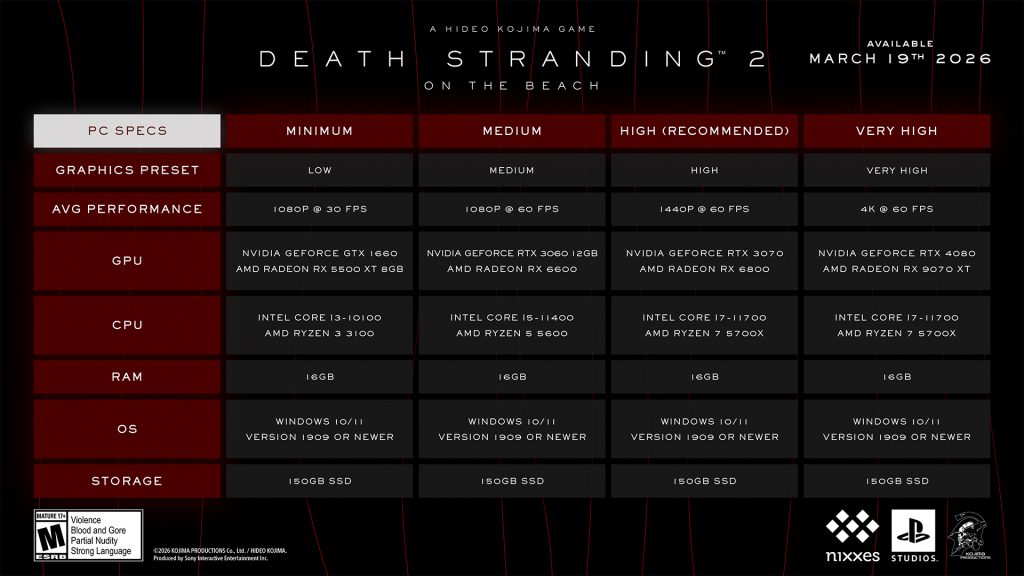
At 1080p, an RTX 3060 — a card that launched in 2021 and now trades second-hand for well under £200, possibly in a shoebox at a car boot sale near you — delivers a locked 60fps. No upscaling required. No compromises. On the kind of mid-range machine a significant chunk of PC gamers already own and have owned for years, DS2 runs beautifully.
Step up to 1440p without upscaling and you need an RTX 3070 or AMD RX 6800. Still mid-range, still entirely achievable, and the visual leap from 1080p is immediately apparent in a game that has clearly decided photorealism is merely a starting point.
“Forty frames per second. A 150GB visual masterpiece. Running through a handheld APU. For £479 new.”
At 4K, the calculus shifts. Native 4K without upscaling demands serious hardware, as it always does and probably always will. But with DLSS Quality or PICO engaged, an RTX 4070 Ti sits comfortably around 80fps in the most demanding environments. The Australian desert biomes — vast, sun-bleached, the kind of landscape that makes you feel insignificant in a way games rarely manage — are precisely where upscaling solutions tend to fall apart. Shimmering heat haze, temporal ghosts on distant geometry, edges that can’t quite make up their mind. PICO, integrated natively with Decima’s sub-pixel jitter and motion vectors, handles these sequences with a stability that FSR 4, impressive as it has become, occasionally struggles to match.
And then there is the Steam Deck.
Nixxes has included a dedicated Handheld preset that is, for once, not simply a “Low” setting wearing a top hat and pretending to be something more sophisticated. It is a bespoke optimisation profile built specifically for portable hardware, prioritising texture streaming and shader pre-caching to eliminate the micro-stuttering that made the original game’s handheld performance a misery best forgotten. On a Steam Deck OLED, with FSR 4 and the Handheld preset engaged, DS2 holds a stable 40fps.
Forty frames per second. A 150GB visual masterpiece. Running through a handheld APU. For £479 new, or considerably less if you know a man who knows a man.
The PS5 version runs at 60fps in Performance mode and looks extraordinary doing it. It also runs at exactly one resolution, with exactly one set of options, on exactly one screen, in exactly one location. The PC version runs at everything from 40fps on a portable device to well over 100fps on a high-end desktop rig. Same game. Same assets. Configurations that could fill a spreadsheet — and for once, that’s entirely a good thing.
The Ultrawide Argument
There is a way of experiencing Death Stranding 2 on PC that no console can offer and no firmware update will ever change.
Full 32:9 Super UltraWide support stretches Kojima’s Icelandic wastelands and rain-hammered highways into a panoramic sweep that makes the standard 16:9 framing feel faintly claustrophobic in comparison. The cutscenes are letterboxed at 21:9 — Nixxes has correctly chosen to preserve Kojima’s specific cinematic framing rather than stretch his carefully composed shots into something resembling a fever dream — but the moment gameplay resumes and the camera pulls back to reveal miles of procedurally-eroded terrain on either side of you, the compromise disappears entirely.
This is not a novelty. Ultrawide fundamentally transforms certain games, and DS2 — a game whose emotional vocabulary is landscape, distance, and the particular loneliness of crossing vast empty spaces — is one of them. Console players are not missing a setting. They are missing a different experience of the same art, one that costs nothing extra if you already own the monitor.
A Word on VRAM — Read This Before You Cry
One important caveat before you max everything out and wonder why your PC is making sounds reminiscent of a distressed animal. DS2 is a memory hog at the top end. On Very High settings at 4K, VRAM usage spikes to around 13.5GB, which means 8GB cards will hit a wall at that particular combination. If you’re running a 3060 or 4060 Ti at 1440p, drop textures from Very High to High. The visual difference is negligible. The stability gain is not. This is one of those genuinely rare occasions where reading the settings menu before ignoring it entirely will improve your afternoon.
Why This Matters Beyond One Weird Postman Simulator
Death Stranding 2 will not be for everyone. The narrative remains Kojima operating at peak Kojima — a celebrity-studded, quantum-physics-adjacent odyssey involving ghostly entities, metaphysical rope theory, and enough cutscenes to constitute a reasonable film career. Whether that sounds like an essential artistic experience or an elaborate endurance test is a question only you can answer, and we respect either conclusion.
But the technical story of this release matters to every PC gamer regardless of whether they care about delivering a single parcel in a game that cares deeply about the act. What Nixxes has built is a template — a demonstration that a single title, given proper attention, can be simultaneously the right game for a £200 second-hand GPU and a cutting-edge showcase for silicon that costs more than a decent holiday. That it can live on a Steam Deck and an ultrawide battlestation and everything between, feeling native to all of them.

The “who has time to fiddle with settings” argument has always been a slight misread of what PC gaming actually offers. Five minutes finding the settings that match your hardware, and then you never think about it again. What you get in return is a game that grows with your system, travels with you, and can reach a fidelity ceiling no fixed console will ever match — because on PC, the ceiling is just the current state of the GPU market, which moves whether Jensen Huang wants it to or not.
Sony’s first-party studios have finally, properly, committed to PC as a platform rather than a seasonal afterthought. Death Stranding 2 is the best evidence yet of what that commitment looks like when someone who actually cares is doing the work.
If you’re playing this on a console, you’re playing the demo. A very good demo, admittedly. But still, it’s clear where the real effort went. If you aren’t playing this on a PC, you’re basically playing the demo.
Death Stranding 2: On the Beach is available now on PC via Steam and the PlayStation PC Launcher. You’ll need at least a GTX 1080 to get in the door, an RTX 3060 for a comfortable 1080p/60fps, and considerably more ambition — and VRAM — beyond that.