
Here is a question the games industry has been quietly avoiding for about a decade: at what point do visuals stop being a feature and start being a distraction?
We’ve arrived at a moment where a game can render individual rain droplets with physics-accurate splatter patterns, simulate the structural integrity of collapsing masonry in real time, and model the way afternoon light catches the dust motes above a corpse — and still feel, when you’re actually playing it, like a bag of spanners being thrown down a flight of stairs.
Crimson Desert is the most extreme version of this argument the industry has yet produced, and it’s worth taking seriously because the question it raises isn’t going away.
Pearl Abyss has built something that is, without qualification, among the most visually arresting PC games ever released. It is also, in its current state, a game that cannot quite decide what it wants to be — and that indecision costs it dearly.
The Case for the Defence
Let’s start where the game earns its keep, because it genuinely does.
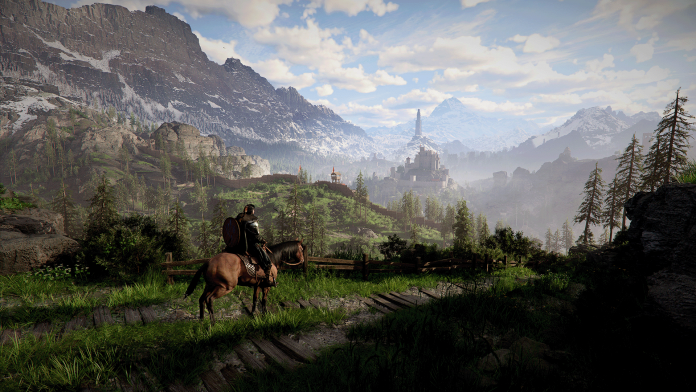
The world of Pywel is staggering in scale. Pearl Abyss’s claim that the map rivals Red Dead Redemption 2 in sheer traversable distance is not marketing hyperbole — a full horseback crossing takes the better part of two real hours, and crucially, the journey never feels like riding through a texture atlas.
The landscape is alive in a way that most open worlds aren’t. Weather systems interact with the terrain dynamically. NPCs have daily routines that exist whether you’re watching them or not. The kind of incidental detail that Rockstar spent years perfecting is here, running on Pearl Abyss’s BlackSpace Engine at a visual fidelity that will make your GPU briefly consider therapy.
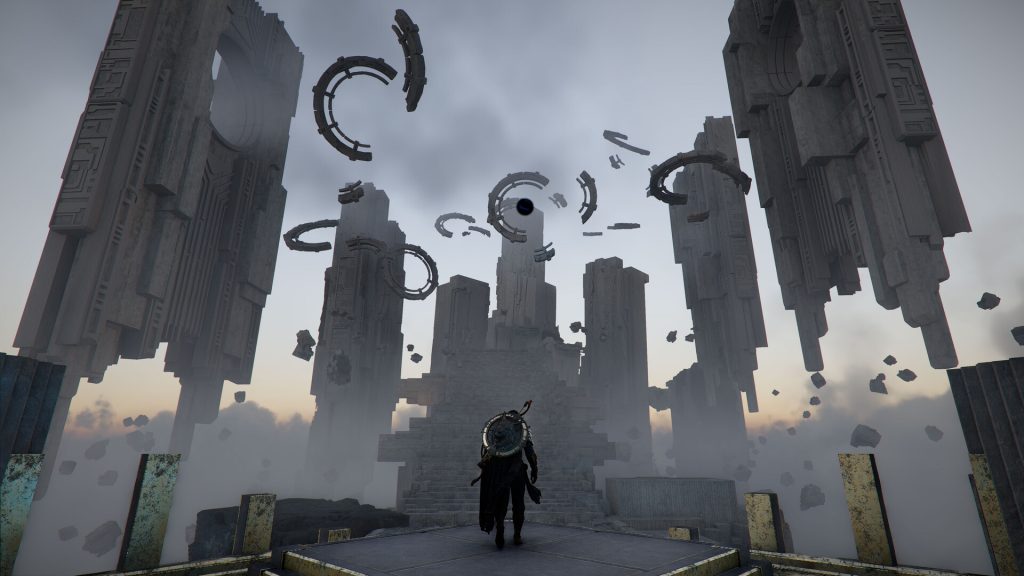
Kliff — your protagonist, a mercenary leader whose beard almost certainly has its own dedicated physics thread — moves through this world with a physicality that feels genuinely earned. The combat is not the mindless button-mashing that the screenshots might suggest. It is closer to Dragon’s Dogma 2 in weight and Breath of the Wild in environmental creativity — you are suplexing enemies off clifftops, improvising with debris, and occasionally making use of the local wildlife in ways the local wildlife finds deeply undignified. When it works, it is spectacular.
The progression system deserves particular mention because it is, in concept, the most interesting thing Pearl Abyss has designed. Kliff doesn’t level up through experience points. He learns by watching — observe a wandering master execute a palm strike, and you can replicate it. Study an enemy’s technique long enough and it becomes yours. It is a system that rewards genuine engagement with the world rather than grinding the nearest dungeon until your eyes glaze over. The idea is excellent.
The Case for the Prosecution
The idea is excellent. The execution, at launch, is another matter.
Crimson Desert arrives on PC having clearly tried to do everything simultaneously — and in attempting to be Witcher 3, Dragon’s Dogma, RDR2, Monster Hunter, and a Pearl Abyss live service game all at once, it has produced something that occasionally feels like five games arguing in a lift.
The control scheme is a labyrinth that takes genuine dedicated study to internalise. The inventory management is the kind of systems design that makes you suspect the UX team had a personal grievance with the player. Bosses, at launch, were capable of stunlocking you into a different postcode — a bug that Patch 1.00.02 has addressed, though somewhat in the spirit of fixing a broken leg with a plaster.
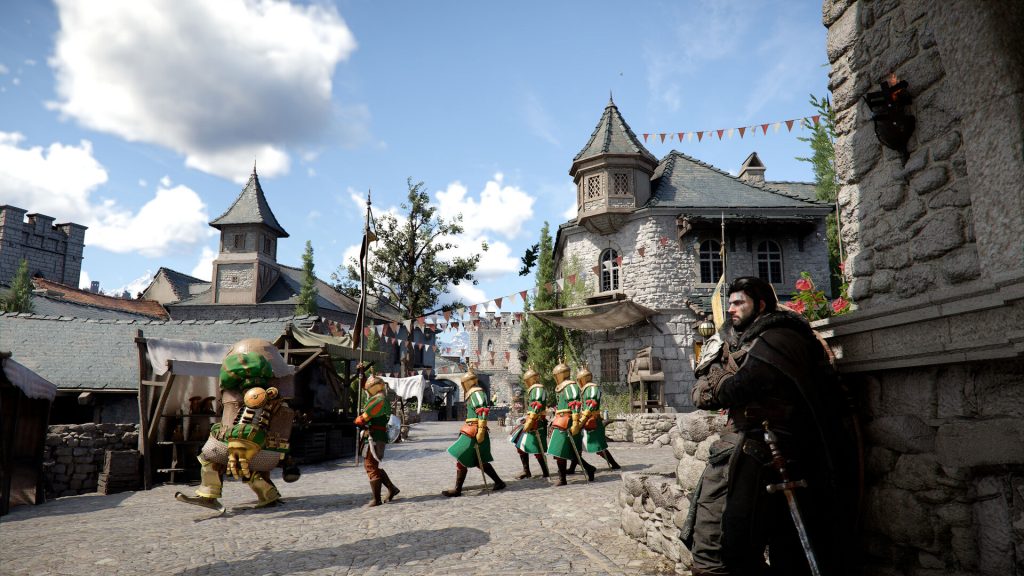
The narrative problem is the most fundamental. Crimson Desert has clearly spent enormous resource on worldbuilding and almost none on giving you a reason to care about any of it. Kliff is a man shaped like a protagonist who acts like a protagonist and sounds like a protagonist, but whose inner life has roughly the emotional texture of a loading screen.
The story moves him from one visually extraordinary set piece to the next with the purposeful momentum of a man who has forgotten why he entered the room but is committed to looking like he hasn’t.
This matters more than it sounds. The Witcher 3 was not beloved purely because it was visually extraordinary for its time. It was beloved because Geralt had a daughter who didn’t remember him, and you felt the weight of that in every sidequest and tavern conversation. The visuals were the world that story lived in. In Crimson Desert, the visuals are the story, and that is ultimately a less interesting proposition — however extraordinary those visuals genuinely are.
The Technical Reality
A brief, necessary word about what this game asks of your hardware, because the answer is: quite a lot, and occasionally unreasonably so.
At standard settings, Crimson Desert is surprisingly well optimised for its visual ambitions. An RTX 4060 pulls a respectable 60fps at 1080p. An RTX 3070 or RX 6800 handles 1440p without complaint. For a game of this scale and fidelity, that is genuinely commendable.
The “Max” lighting setting is a separate conversation entirely. Enabling Pearl Abyss’s Ray Reconstruction mode — which transforms the lighting from “very pretty” to “indistinguishable from reality in places” — introduces a roughly 50% performance penalty that has been observed dropping an RTX 5080 from 79fps to a distinctly cinematic 35fps at 4K.
Unless you are running the game on hardware that costs more than a second-hand car, treat “Max” as a benchmark mode rather than a playable one. At Very High, the game looks extraordinary. At Max, it looks extraordinary and runs like a philosophical argument.
One further warning: Intel Arc GPU owners are currently stranded. Optimisation for the blue team is, at time of writing, non-existent. This will presumably be addressed, but for now, Arc owners should wait for a patch before handing over their money.
The Bigger Question
So. Can Crimson Desert’s visuals save it from its gameplay problems?
The honest answer is: partially, temporarily, and only if you meet it halfway.
There is a version of this game — patched, modded, iterated on by a developer that has shown real capacity to improve its work post-launch — that will be considerably closer to the masterpiece the trailers implied.
The Witcher 3 launched with interface problems. Cyberpunk 2077 launched as a cautionary tale and became a genuine classic. Games like this, with this much world built into them, have a track record of ageing into their own ambitions. The bones here are extraordinary. The flesh needs work.
“You arrive at a game that looks like the future and plays like a committee argument about what games should be.”
But there is also a more uncomfortable version of the question that the games industry needs to sit with. Visual fidelity has become, for certain developers, a substitute for the harder creative work of making a game that feels worth inhabiting for reasons beyond its appearance.
Crimson Desert is not cynical — it is clearly the product of developers who genuinely love what they’ve built and got somewhat carried away — but it does represent a genre tendency that is worth naming.
You arrive at a game that looks like the future and plays like a committee argument about what games should be. A game this beautiful deserves a story, a control scheme, and a protagonist worthy of the world around them. Right now, it has the world. The rest is a work in progress.
If you value a highly polished, consistent narrative experience, you’ll probably align with IGN’s 6/10. But if you prioritise exploring a vast, chaotic, and madly-ambitious sandbox, you’ll likely find the game considerably more enjoyable than they did.
The mood music around Crimson Desert is getting more upbeat by the day — Pearl Abyss are patching with monastic devotion, and the game is better for it every week.
Come back in six months. By then, the modding community will have sorted the inventory, the worst bugs will be history, and Pywel will finally be the place it always looked like it could be from the outside. Whether that constitutes a recommendation or a survival strategy probably depends on your patience threshold.
Either way, your GPU is going to have opinions about it.
Crimson Desert is available now on PC via Steam. Minimum specs require a GTX 1080; recommended 1080p/60fps requires an RTX 4060 or equivalent. Install size is a commitment-testing 150GB.