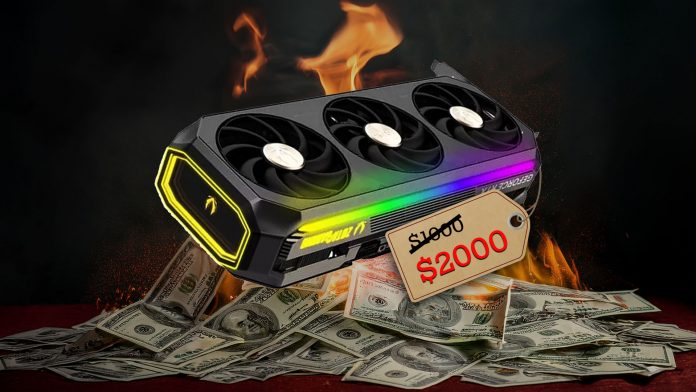

Another day, another graphics card launch, another opportunity to scream into the void about how “MSRP” now apparently stands for “Maybe Sometimes Reasonably Priced.”
Remember when you could actually budget for a new GPU based on the price listed on the manufacturer’s website? Those were simpler times. These days, that number is about as real as the cake from Portal.
The Problem with the “Price”
The RTX 5060 Ti 16GB model launched with an MSRP of £399. A reasonable price for a low-to-mid-range GPU in our price-inflated 2025 world. Reasonable. Understandable. Almost believable. But visit any online retailer and you’ll find listings averaging £499 at the time of writing. What happened? Did the extra £100 unlock a secret level?
And then there’s the upcoming AMD RX 9060 XT. No UK pricing yet, but the US MSRP is $349 for the 16GB model — and seriously, don’t waste your money on an 8GB card. According to PC Gamer, early Amazon listings already have the card at $549. What the actual fuck. But don’t worry — it comes with an LED strip and an extra fan you absolutely didn’t ask for.
This isn’t new, of course. We’ve been down this road before. Pandemic-era GPU shortages showed the market just how much people were willing to pay when desperate, and the industry took that as a green light to never go back to normal.
It’s Not the Pandemic Anymore
For a while, yes, there were real explanations. Global chip shortages, shipping delays, and crypto mining surges conspired to make GPUs rarer than a stable Bethesda launch. But those days are largely behind us. Supply chains have stabilised, crypto has calmed down (for now), and you can actually find GPUs in stock.
And yet, the prices stay inflated.
Why? Because we let them. Because enough people paid the inflated prices. And now, like that friend who got too comfortable crashing on your couch, the markup won’t leave.
The Third-Party Problem
When AMD or NVIDIA releases a new GPU, they manufacture only a small number of “reference” cards. The bulk of units are built by third-party vendors — ASUS, MSI, Gigabyte, Zotac — who slap their own coolers, RGB lighting, and marketing slogans onto the silicon before sending it to retail.
The problem is that these vendors aren’t beholden to MSRP. They source the chip, bolt it onto a custom board, add a cooler that looks like it was designed for a fighter jet, nudge the clock speeds up slightly, and then price it however they like. $200 above MSRP? Why not — look, it has a marginally better fan and the box glows. Retailers compound this further; the moment demand ticks up, prices follow. The system is designed, whether intentionally or not, to ensure that the number AMD or NVIDIA publishes on launch day has almost no bearing on what you’ll actually pay.
Why Does This Only Happen with GPUs?
Other tech products don’t suffer this problem to the same degree. Motherboards and CPUs don’t routinely launch at a “suggested” price and then immediately appear everywhere for £150 more. Even games consoles — arguably as hot a commodity as GPUs at launch — tend to hold much closer to MSRP.
Graphics cards are uniquely vulnerable to this for a few interconnected reasons. Unlike CPUs or consoles, GPUs are one of the only major consumer electronics where the chip designer largely outsources the physical product to partners, and those partners aren’t bound by the designer’s pricing. That fragmented production model creates a gap between what AMD or NVIDIA say a card costs and what it actually costs, and the market fills that gap with markup.
The MSRP becomes an artefact — a number that existed briefly on a press release and nowhere else.
There’s also the question of competition — or the lack of it. NVIDIA controls the lion’s share of the discrete GPU market. AMD competes, but from a significant distance. Intel’s Arc cards are still finding their feet. With real alternatives limited, consumers face a straightforward choice: pay what the market demands or don’t play. That’s not a market that self-corrects. That’s a market that extracts.
Gaming culture doesn’t help either. New GPU generations are treated like major events. Influencers publish benchmark videos weeks before launch, hype reaches fever pitch, and by the time cards are available, demand has already gone feral. Pre-orders evaporate. Scalpers move in. The MSRP becomes an artefact — a number that existed briefly on a press release and nowhere else.
What Can Be Done? (Honestly)
The most commonly suggested fix is for AMD and NVIDIA to manufacture more of their own reference cards and sell them directly, cutting out the partner markup. It’s an appealing idea and not a bad one — if you can buy a card at MSRP from the manufacturer’s own store, that creates at least some market pressure on third-party pricing.
But it’s worth being honest about the limits here. AMD and NVIDIA’s relationships with board partners like ASUS and MSI are contractual, long-standing, and commercially significant. Pivoting to meaningful direct sales would mean renegotiating those relationships, scaling up their own manufacturing and logistics infrastructure, and accepting the kind of retail responsibility they’ve happily offloaded for decades. It’s not impossible, but it won’t happen because a few tech journalists think it’s a good idea.
What’s more achievable — and what both companies could do tomorrow if they chose to — is stricter pricing enforcement. They could require that reference-spec cards be sold at or near MSRP as a condition of the licensing agreement. They could make reference cards genuinely widely available rather than treating them as limited-edition collector’s items that vanish within hours. They could stop pretending that a price they have no intention of enforcing is a meaningful number.
We’re not asking for miracles. We’re asking for honesty. If a GPU is going to cost $599, set the MSRP at $599. Don’t say $399 and let the entire retail chain pile on surcharges like they’re itemising a hotel bill.
Give Us a Break
GPUs are one of the most important components in a gaming PC. They drive visual fidelity, power AI workloads, and yes, occasionally mine cryptocurrency into oblivion. They should not be priced like luxury goods with a notional discount printed on the box.
The pandemic excuse is dead. Supply chains are stable. Materials are available. What isn’t available, apparently, is any willingness from AMD or NVIDIA to take ownership of the gap between what they say their products cost and what consumers actually pay.
Until that changes, the GPU market will keep feeling exactly like what it is: a back-alley auction where everything has a reserve price, the auctioneer invented the catalogue values, and everyone’s bidding with Monopoly money.