
NVIDIA is at it again. At GTC 2026, Jensen Huang took to the stage to announce DLSS 5 — a technology he’s calling the “GPT moment for graphics.” If you thought we were done arguing about fake pixels, buckle up, because we’ve officially moved past faking frames and into the realm of faking reality itself.
The pitch is straightforward enough: brute-force rendering is dead. To get Hollywood-grade visuals inside a 16-millisecond game frame, NVIDIA is deploying a real-time neural rendering model. Instead of your GPU agonising over every ray of light like a Victorian watchmaker, DLSS 5 takes the game’s basic colour and motion vectors and uses a generative AI model to “infuse” the scene with photoreal lighting and materials.
On paper? It sounds like magic. In practice? NVIDIA’s own reveal was, frankly, an embarrassment.
The Yassification of Resident Evil
For a company sitting atop the technology throne, NVIDIA’s marketing team has once again managed to trip spectacularly over its own shoelaces. The reveal featured footage from Resident Evil: Requiem that was supposed to showcase “unprecedented realism.” Instead, it looked like someone had dragged the game through a high-end beauty filter on TikTok.
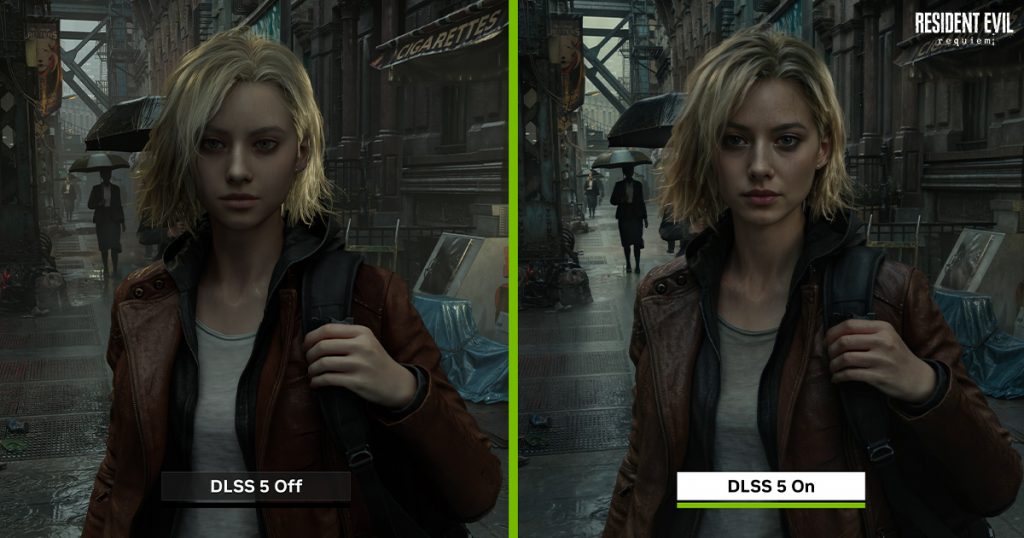
Take poor Grace Ashcroft, the lead in Requiem. In the DLSS 5 “enhanced” footage, she didn’t look more realistic — she looked like she’d been dipped in Vaseline and given digital lip filler. Her face was airbrushed into oblivion, stripping away the actual art direction of Capcom’s artists in favour of a weird, AI-flavoured sheen that would make a Instagram influencer wince.
Even Leon S. Kennedy — a man who has survived Raccoon City, a Spanish cult village, and roughly thirty years of being shot at for our entertainment — couldn’t survive NVIDIA’s “visual breakthrough.” He emerged looking less like a grizzled government agent and more like a sleep-paralysis demon who’d recently discovered a boy-band wig and committed to the bit.
It is a classic NVIDIA own-goal. They’ve taken a genuine technical breakthrough — the ability to render complex lighting and skin textures in real time — and presented it with all the grace of a toddler showing off a finger painting. What should have been a “Master Race” victory lap became cheap, generative slop that actively ignored the intent of the artists who made the game. Capcom’s design team did not spend years crafting Grace’s character model so an AI could smooth her into a glazed mannequin at the press of a toggle.
To be fair to NVIDIA, the follow-up Grace image looked considerably better — which raises its own question about exactly what the first batch of screenshots was meant to demonstrate, and why nobody in the building apparently thought to use the better-looking version first.
The Dual-5090 Elephant in the Room
Here is the part that should concern everyone far more than the beauty filter controversy.
To show us this supposedly “efficient” future of AI-driven visual fidelity, NVIDIA needed approximately £4,000 worth of GPUs
According to Digital Foundry, who had an in-person first look at the technology, the live demonstration was running on two RTX 5090s. Two. In a multi-GPU configuration that NVIDIA spent several years quietly pretending wasn’t still a thing.
Yes. To show us this supposedly “efficient” future of AI-driven visual fidelity, NVIDIA needed approximately £4,000 worth of GPUs and enough electricity to power a reasonably sized village in Surrey. It is genuinely difficult to get excited about software magic when the hardware prerequisites are currently operating in the realm of science fiction for the overwhelming majority of the planet’s gaming population.
Unless you are a cryptocurrency millionaire, a professional competitive gamer with extremely generous sponsorship, or someone who has successfully robbed a microchip factory, you will not be “infusing” your pixels with anything other than sadness and existing DLSS 4.5 for the foreseeable future.
This matters. NVIDIA’s entire pitch for DLSS since version 2.0 has been efficiency — getting more out of less, democratising visual quality, letting mid-range cards punch above their weight. The dual-5090 demonstration is the opposite of that message, and the optics are dreadful at a moment when GPU pricing is already one of the most toxic conversations in PC gaming.
Wait and See — Before You Burn the House Down
None of this means DLSS 5 is without merit. Underneath the beauty filter fiasco and the science-fiction hardware requirements, something genuinely interesting is happening.
We are entering a period where the game engine provides the skeleton and AI provides the skin and the lighting. Whether that’s philosophically troubling or simply the next step in a technology that has been evolving since the first polygon was rendered on a home PC depends on who you ask — and the answer says more about the person than about the technology.
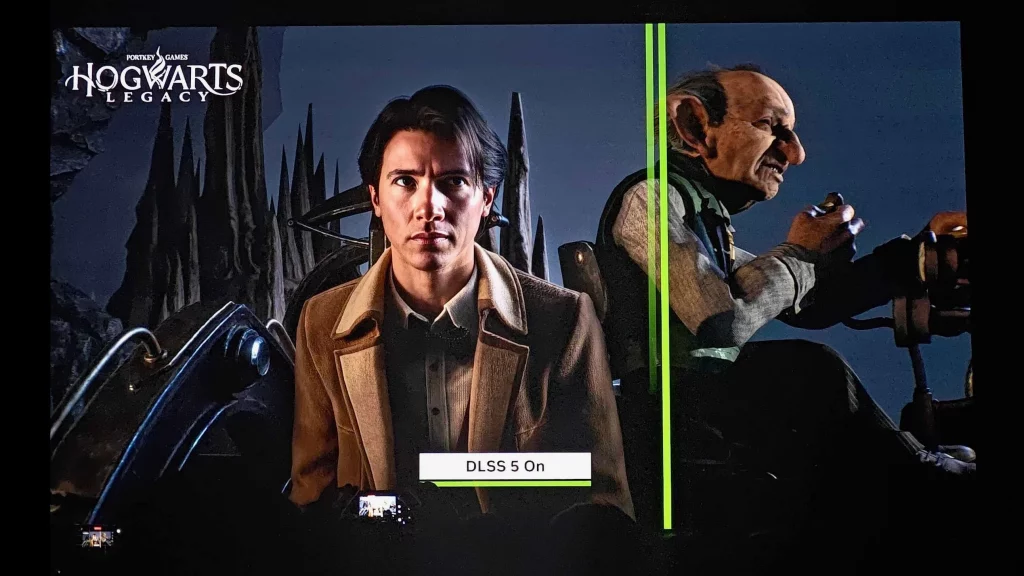
What is inarguably true is that NVIDIA’s first showing is almost never their best. DLSS 2.0 launched with ghosting problems that were significantly improved within months. DLSS 4.0 arrived with Frame Generation quirks that subsequent updates addressed. The pattern is consistent: the first reveal is the shakiest version of the technology, and the version that ships in games six months later is meaningfully better.
DLSS 5 will almost certainly follow the same trajectory. The “Vaseline filter” footage is a worst-case demonstration of what happens when a generative model is allowed to overcorrect, and it is not representative of what the technology will look like when Capcom, or any other developer, has had time to tune the implementation for their specific art direction.
The real question — the one that will take considerably longer to answer — is whether AI infusion of lighting and materials is a tool that enhances an artist’s vision or one that gradually replaces it. That is not a question NVIDIA’s GTC presentation was interested in addressing, and it is the question that the gaming community’s fury is really about, even when it expresses itself as memes about lip filler and boy-band wigs.
The Verdict — For Now
DLSS 5 is coming. It will be controversial, it will be transformative in some contexts, and it will be optional — which remains the correct response to anyone currently composing a manifesto in the comments.
NVIDIA has taken a genuine technological leap and wrapped it in marketing so clueless it made the future of gaming look like a TikTok filter. That is an extraordinary achievement in its own right, and not one they should be proud of.
We will reserve final judgment until this runs on hardware that doesn’t require a dedicated power substation. Until then, DLSS 4.5 is right there, it works beautifully, and it costs exactly nothing extra to keep using it.
Jensen’s pixel-pushing magic will get another chance to impress. We’ll be watching.